Poke-Ball Pinball – How to Play!
Tourney Outline:
- Four Matches of Group Matchplay with 5/3/2/1 scoring
- Matches consist of two games – one Modern and one Classic
- Gameplay and scoring is modified by Pokemon-themed cards, most importantly:
- Players each have a Bench (their Pokemon) and a Trainer Deck (their non-Pokemon cards)
- Each machine has a Stadium Deck, with various Stadium cards. At the start of the game one is flipped on each machine; its effects apply to all players at that machine.
- Each player has a Score Modifier (SM) that affects their end-of-game score, prior to assigning Tourney Points. Players may have only one SM at a time; any time an SM would be applied and a player already has one, the first is removed.
- Some cards or effects may add or subtract a Tourney Point
- Top 8 Proceed to finals (Same format, top 2 in each group advance)
Basic Gameplay
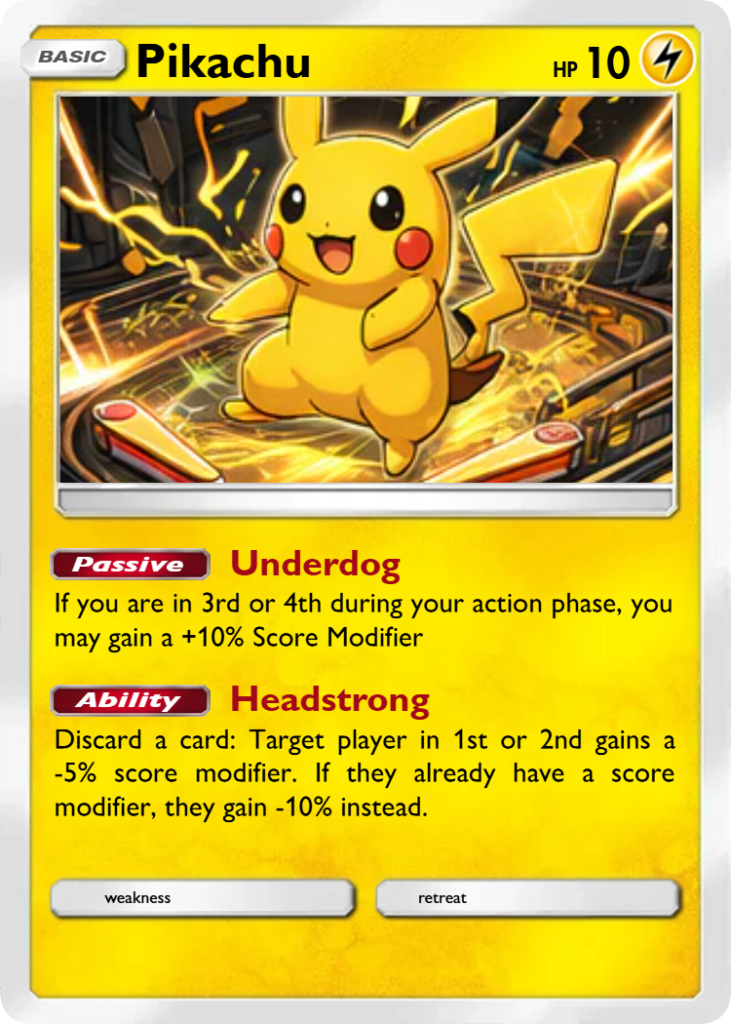
- At the start of the tourney, each player is given a random Starter Pokemon and three random cards
from the Master Deck (the master card pool held by the TD). - Opponents and arenas are assigned in matchplay. Players gather at their first arena but do not pay for their game yet. (cards and effects may change the arena prior to starting)
- Each player selects one Pokemon from their Bench (pool of Pokemon Cards) and place it on the
machine’s apron in assigned player order. - Any passive effects from Pokemon or the Stadium in play resolve. These may change games, pokemon, stadiums, or player order – resolve accordingly before moving on.
- Each player draws two cards from their Trainer Deck (pool of non-Pokemon cards).
- The first Action Phase (AP) happens: following player order, each player has 10 seconds to do ONE ofthe following:
- Play ONE card. It is Discarded to the bottom of that player’s deck unless the card says otherwise.
- Use ONE Pokemon Ability
- Pass
- Once all players have taken their AP or forfeited for screwing around, players play ball one as usual.
- After all players have played ball one, each player takes their second AP in turn as before, then all play ball two as usual. Same story before ball three.
- At the end of the game:
a. Any end-of-game effects from Stadiums or Pokemon resolve
b. If players have Score Modifiers (SM), those are applied to their final game score.
c. Players enter their game results in Matchplay based on scoring after SMs are applied
d. Players move to their second Arena and proceed from step 3. Matches repeat likewise. - At the end of each Match, players draw one additional card from the Master Deck. Players in the bottom 75% are given an additional Pokemon to add to their Bench.
Score Modifiers
- If a player has a Score Modifier at end-of-game, that player adds or subtracts that much from their score prior to match points being assigned.
- A player may have no more than one Score Modifier at any time. If they would gain a second, the first is immediately removed.
- Physical tokens are available at each machine; place on that player’s Pokemon card for easy tracking.
Action Phases
- Each game has three action phases – one before the group starts each ball. Players take their action phase in turn following Player Order for that game.
- During a player’s Action Phase, they have 10 seconds to EITHER play ONE card or use ONE Pokemon Ability.
- If they are not present or dick around being indecisive for more than 10 seconds, they forfeit their Action Phase. No exceptions – get your shit together and don’t waste other’s time.
Stadiums and Passives
- Each machine has a small Stadium Deck. At the start of the tourney, the TD flips over a Stadium for each. While it is in play, any effects listed on it apply to games on that machine.
- Cards or Pokemon may change the stadium – if so, place it on the bottom of the deck. Its effects end
- immediately, and the new Stadium’s immediately take effect.
- Pokemon also have Passives – these effects apply at all times as long as they are in play.
Card and Ability Costs
- Cards and Pokemon Abilities often have additional costs, including:
- Discarding additional cards from your hand. When a card is played, that card is always discarded.
- Burning a card from your hand by permanently discarding it back to the TD’s Master Deck
- Gifting a card by placing it on the bottom of an opponent’s deck (they gain permanent control of it)
- Plunging one of your balls instead of playing
- Match: a set of two games
- Tourney Points: Awarded after each game of a match, based on final score position after applying any score modifiers.
- Pokemon: Creature cards with passive and activated abilities that apply to the player controlling them. Each player places one Pokemon of their choice from their bench in play at the start of each Game.
- Stadiums: Cards present at each Machine, which modify gameplay for all players on that machine.
- Cards: General one-off effect cards. When a card is played, it is always placed immediately on the bottom of that player’s Trainer Deck unless that card or another effect says otherwise.
- Score Modifier: A percentage adjustment applied at end-of-game to each player, prior to assigning Tourney Points
- Action Phase: Phase where players have the opportunity to play EITHER one card or one pokemon ability. These happen prior to any player playing ball one, two, and three, and proceed in player order for that game.
- Passive: Persistent effects from Pokemon or Stadiums that apply to one or more players as long as that card is in play. These effects end immediately if the card leaves play.
- Ability: One-off effects from Pokemon that may be used during your Action Phase
- Master Deck: The TD’s master pool of cards
- Bench: Each player’s personal pool of Pokemon not in play.
- Trainer Deck: Each player’s pool of non-Pokemon cards.
- Stadium Deck: The deck of Stadium cards present at each machine.
- Discard: Place the card on the bottom of the appropriate deck.
- Burn: Discarding a card back to the Master Deck.
- Gift: Place a card on the bottom of an opponent’s deck – they control it permanently.
- Plunge: Skip a ball by plunging it – you may not touch the flippers.